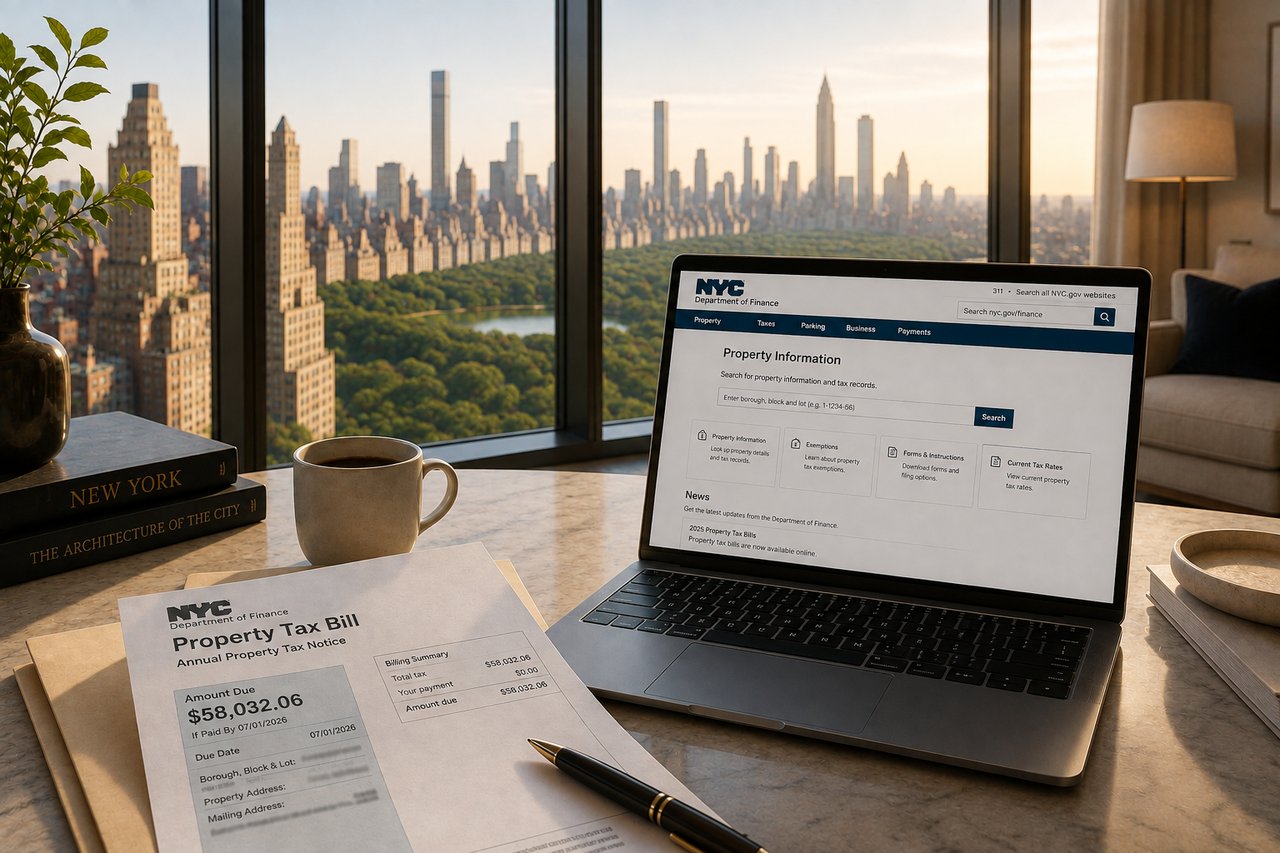
If you own a New York City home that isn't your primary residence, the city just made that a lot more expensive. A new annual surcharge on high-value, non-primary residences took effect on July 1, 2026, and is set to run for five years. Whether you own a pied-à-terre, a rarely used condo, or an investment unit, this is a tax you need to understand now, not after your first bill arrives.
The Department of Finance has extended the deadline to respond and apply for an exemption to September 18, 2026, pushed back from the original August 21 deadline. This extension applies specifically to owners who received a notice stating their property "may be subject to" the surcharge and believe they qualify for an exemption, most commonly because the property is genuinely a primary residence. If you received one of these letters, you’re encouraged to submit your documentation as soon as possible rather than waiting until the new deadline approaches.
The scale of the rollout has already surprised the market. The provisional list of potentially affected properties includes more than 31,000 homes, far exceeding earlier estimates that 10,000 to 13,000 properties would be subject to the tax, and the final list of homes actually subject to the levy will be published on December 31, 2026.
What Exactly Is This Tax?
Officially called the non–primary residence surcharge, it's an annual charge on the property itself, not on the person who owns it. That distinction matters: this surcharge stacks on top of your regular property tax bill, and any exemptions or abatements you already receive on that bill won't reduce it. The surcharge is scheduled to apply from July 1, 2026 through June 30, 2031.
In plain terms, the city is targeting homes that are not legally treated as someone’s primary residence, regardless of how often they’re actually used. If the property doesn’t qualify as a primary residence under the rules, and it meets the value thresholds, it’s in the surcharge net.
Which Properties Are Affected?
Not every home in the city is caught by this law, and the thresholds vary by property type during the first two years (Phase 1, running through June 30, 2028).
One, two, and three-family homes must have a Department of Finance market value of at least $5 million. If even one unit in the building is someone’s qualifying primary residence, the whole building is exempt.
Condo units generally fall under a $1 million Department of Finance (DOF) market value threshold, though a subset of condos in certain small-scale, tax class 1 buildings use the $5 million threshold instead.
Co-ops also use the $1 million threshold, but here the value is calculated indirectly: the Department of Finance imputes unit value by multiplying the co-op corporation’s total market value by your proportionate share of ownership.
Some categories are excluded no matter their value, such as vacant land, buildings lacking a certificate of occupancy, unsold sponsor units, and bungalow colonies.
Market Value vs Assessed Value
One of the biggest misconceptions about New York City's new pied-à-terre tax is that the $1 million threshold refers to a property's purchase price or current sale price. It does not. The threshold is based on the New York City Department of Finance’s market value estimate for tax purposes, which is different from both the price you paid and the smaller “assessed value” number used to calculate property tax bills.
For condos and co-ops, the City does not simply use recent sales prices. Instead, it applies its own valuation methodology, which often results in a DOF market value that is significantly lower than what the apartment would sell for on the open market. For example, a condominium with a market value of $4 or $5 million in the marketplace may have a DOF market value of less than $1 million, meaning it would not be subject to the tax even though its true sales value is much higher.
Conversely, a luxury apartment worth substantially more could exceed the threshold because its DOF market value reaches $1 million or more; high-profile trophy properties can carry very high DOF market values compared to ordinary units in the same building. The important takeaway is that the new tax is based on the City’s estimated market value for tax purposes, not the price you paid for your home or what it is currently worth in today's market. To find out the DOF market value of your apartment, visit the NYC Department of Finance’s online property lookup portal.
How Much Will Owners Actually Pay?
This is where the tax gets serious, and where condo and co-op owners take the biggest hit early on.
During Phase 1 (through June 30, 2028), one to three-family homes with DOF market value above $5 million are taxed at 0.8% to 1.3% of market value, scaled up in tiers as value increases. Condos and co-ops face a much steeper bracket: 4% for properties with DOF market value between $1 million and $3 million, 5.25% between $3 million and $5 million, and 6.5% above that, with the applicable rate applied to the property’s entire value once the threshold is crossed, not just the portion above it. That means a $6 million non-primary townhouse could owe roughly $48,000 to $78,000 a year, and a $3 million non-primary condo could face a $120,000 bill, purely from this surcharge.
Phase 2, beginning July 1, 2028, evens things out considerably. All property types shift to the $5 million DOF market value threshold, condos and co-ops move to a comparable-sales valuation method instead of the imputed share calculation, and everyone pays the lower 0.8%–1.3% set of rates used for one to three-family homes. The takeaway: the pain is heaviest in the first two years, especially for mid-value condos and co-ops in the $1 million–$5 million DOF market value band.
The Primary Residence Question Is Everything
This isn't a vacancy tax. A home used every weekend can still be surcharged if it isn't legally someone's primary residence, while a temporarily empty home can stay exempt if it still qualifies as one under the rules.
A property counts as a primary residence if it's the main home of the owner, or of the owner's spouse, child, sibling, parent, grandparent, or grandchild, or of a tenant under a genuine, arm’s-length lease of at least a year. You (or a qualifying relative) can only claim one primary residence citywide, so if a family genuinely splits time between two NYC homes, only one gets the exemption for surcharge purposes.
For investors, renting out a unit under a real, year-long lease can shield it from the surcharge, provided you can document that the tenant uses it as their primary residence. Month-to-month arrangements require additional affidavits and supporting proof, and leases that appear designed mainly to dodge the tax rather than reflect a genuine rental arrangement may not qualify.
Why January 5 Is the Date to Remember
Every year, the city uses January 5 as its “taxable status date”—whatever is true about your property's value and occupancy on that day determines your liability for the coming fiscal year. For the current cycle, January 5, 2026 set the baseline; the Department of Finance published its initial list of potentially affected properties on July 24, 2026, and owners have until August 30, 2026 for DOF to issue initial determination notices, with the first surcharge payment due in January 2027 alongside regular property taxes.
Going forward, any change you want to count such as moving in, adding a qualifying family member, signing a valid lease, must happen on or before January 5 to affect that year's tax. Selling mid-year to a buyer who'll live there full-time won't undo the surcharge for the year already locked in, and there is generally no proration based on partial-year primary use. Conversely, if you are purchasing a qualifying property from an owner who did not use it as their primary residence on January 5, you could be on the hook for the pied-à-terre tax for that year even if you intend to make the home your primary residence.
Appeals and Proof
If your income tax records don't clearly show the property as your primary residence, the city may issue an initial determination that you owe the surcharge. From there, you generally have two separate paths: a Department of Finance appeal focused only on primary-residence status (due within 30 days of the notice), or a Tax Commission challenge that can address both valuation and residence status, with deadlines of March 1 for condos and co-ops and March 15 for one- to three-family homes.
The strongest evidence is your most recent state or federal tax return listing the property as your permanent home address. Absent that, you'll need two forms of supporting documentation, such as a New York driver's license or voter ID showing that address, paired with other acceptable occupancy proof. Worth noting: documents submitted in this process aren't shielded by the usual tax-secrecy protections in the same way as standard tax filings, so think carefully about what you disclose and coordinate with your advisers.
Owners should also note that the exemption application deadline itself has already moved once: it was extended from August 21 to September 18, 2026 for anyone who received a "may be subject to" notice from the Department of Finance. If that's you, don't wait for the new deadline to arrive. Applying early gives you more room to gather documentation and resolve any issues before the window closes.
Special Cases Worth Flagging
The rules get more intricate for certain ownership structures.
LLCs and corporations can still qualify for exemption, but only if the entity owns the property outright and the people living there as their primary residence (or their qualifying family members) collectively hold more than 50% of the entity. If the qualifying residents do not collectively own more than half the equity, for example, a purely 50/50 structure where neither owner lives there, the property will not qualify for a primary-residence exemption.
Layered structures, such as an LLC owning another LLC that owns the property, generally don't qualify for the entity-based primary residence rules. Trusts can qualify if the residents are the trust's only current, or “present,” beneficiaries, with contingent or future beneficiaries disregarded. Life events like death, hospitalization, or a stay in a care facility can preserve primary-residence status for up to a year, though the rules don't clearly define how "temporary" a stay can be, which is particularly important for estate sales and long medical absences.
Co-op Owners Face Extra Complexity
Because co-op values are imputed rather than directly observed from individual unit sales, the city doesn't disclose the underlying calculations behind your unit's DOF market value, making valuations hard to challenge on their own terms. The co-op corporation itself is responsible for collecting the surcharge from shareholders, and unpaid amounts can create a lien against the entire building, making this as much a board-level concern as an individual one.
One useful wrinkle: while each co-op unit must file its own Tax Commission application, a market value determination for one unit in a building may be considered in valuing other units in the same building for the same year, which is a rare exception to the usual rule that determinations don’t carry over.
What to Do Now
If you own or are considering a high-value non-primary residence in New York City, treat January 5 as your planning deadline every year. Review your occupancy patterns, gather documentation early, and don't wait for a mailed notice. Check the Department of Finance's published lists yourself and pay attention to updates from the city. Buyers and sellers should also start addressing surcharge responsibility explicitly in contracts, since the tax follows the property rather than the previous owner.
The new surcharge is expected to raise hundreds of millions of dollars annually and is being closely watched for its impact on the city’s luxury market, with industry leaders already warning it may chill demand and push some second-home owners to sell. Whether that proves true or not, the compliance and planning burden for high-value owners is now a permanent part of the NYC conversation, at least through 2031.
This overview is for general information only and isn't legal or tax advice. How the surcharge applies depends heavily on your specific property, ownership structure, and occupancy situation. Talk to your tax and legal advisers before making decisions.
Julia Boland is a Manhattan residential real estate specialist at Corcoran with over 25 years advising buyers and sellers on NYC co-ops, condos, and townhouses. She is the author of Buying Smart in NYC: An Insider's Guide to Condo & Co-op Buying (2026). Whether you're just starting your search or ready to make a move, Julia and The Boland Team are here to help. Reach out at thebolandteamnyc.com or call (848) 200-1452.